Photos from one guy's travels around the world -- from UNESCO World Heritage Sites to national parks to his own backyard in Colorado, and lots of places in between.
Monday, June 19, 2017
East End Galveston: June 2017
It didn't take long for my decision to be rewarded. Two dark blobs on an old telephone pole revealed themselves as we approached to be a pair of Crested Caracaras!
I startled Taryn a bit by making a u-turn then pulling off the road and grabbing my camera. I'd seen one of these beautiful birds for the first time on a fence post near Anahuac National Wildlife Refuge last year, but it flew off before I could get a picture of it. I didn't want that to happen again!
Fortunately, I was able to get a shot of the two together. The one on top of the pole signaled it was about to take off in a way I've seen before in raptors -- by pooping. Needless to say based on their relative position, the one beneath it seemed somewhat surprised and displeased by its decision.
Sure enough, the first flew off. But to my delight the second took its place atop the pole and stayed. I slowly walked closer, noticing even more excrement on its head plumage and an expression of continued disbelief.
My past experience shooting raptors is that they tend to be fairly skittish, even atop tall poles where I can't possibly be a threat to them. But this bird seemed unperturbed. Projecting human emotions like we do, it now looked somewhat embarrassed that I had been a witness to the unfortunate pooping incident.
I was caught off guard by the sudden return of the pooper! The bird I'd been shooting abruptly flew off, only to be replaced by its partner. I didn't get anything usable of the takeoff or arrival. But once atop the pole, the bird stayed nice and still for me.
More than satisfied with what I'd gotten from the Caracaras, I returned to the car and we drove to the park at the end of the road. There was a charge for parking that I didn't feel like paying, so we decided to just head back. But not before I caught a nonbreeding Laughing Gull splashing about a bit in a large puddle.
As all nature photographers can attest, there's always time for one more stop! So we pulled into the parking area for Fort San Jacinto Historic Point to walk the shore a bit. First sighting -- a breeding Laughing Gull in some nice light.
I watched this Reddish Egret for a while. It seemed pretty relaxed, perched there on one leg. I'm really not sure what it decided to squawk at on the ground.
Close the beak, turn the head, and you get a very different vibe from this shot. Much more tranquil and serene. The pink color on the water? A fisherman standing off camera.
It wasn't quite magic hour when we decided to finally be truly done, but the sun was still low enough in the sky to provide some terrific light on this Brown Pelican.
A great end to our first day on the coast!
Monday, June 26, 2017
Bolivar Peninsula: June 2017
First, it's not efficient to plan on taking the ferry back and forth in the same day. I spent a couple of hours on both trips just sitting and waiting. Next time, I'll do my Bolivar birding on the way to and from Galveston and once I get to the island, stay there until it's time to leave.
Second, the birding on Bolivar is so good that it almost makes the time lost waiting for the ferry worth it.
I stopped at Rollover Pass on our drive in and hit all four corners to see what I could see. The northwest corner was where the action was, including this Black-crowned Night-Heron with a little breeze in his head plumage, standing in a spot visually free of both fishermen and trash!
Speaking of fishing, a small group of Laughing Gulls was hovering around some folks who were doing just that apparently hoping for a handout or dropped scrap. I was glad to get something sharp and well lit of an isolated bird.
Frenchtown Road on the far west end yielded a sleepy Willet ...
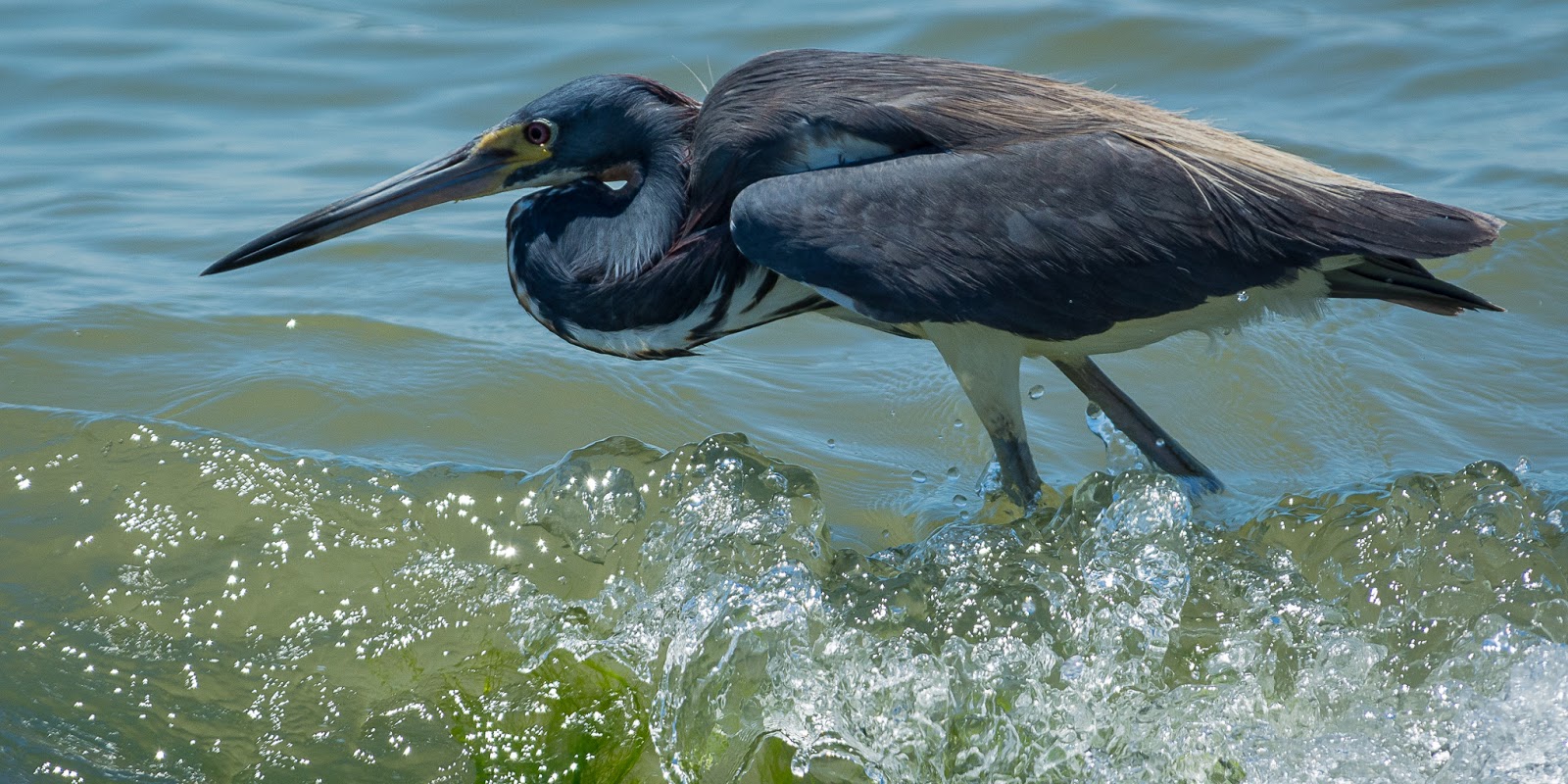
... and a Tricolored Heron hunting in the surf.
Fort Travis Park didn't have much, but this juvenile Black-crowned Night-Heron made itself available on the side of the entrance road.
I found a cormorant on a fence post at Bolivar Flats. I'm calling it a Neotropic based on tail length, but I won't be shocked if someone on iNaturalist disagrees.
I love getting nice, crisp shots of birds on barbed wire. This Scissor-tailed Flycatcher is a nice addition to the collection.
Yacht Basin Road had a small, spread-out group of White Ibis, Roseate Spoonbills, and Snowy Egrets. I got out of my car to approach for better shots, but they seemed very aware of my presence and not all that excited about it. So I contented myself with a few long snaps like this one and retreated.
My withdrawal turned out to be well-timed, as as soon as I got back to my car an osprey with a meal landed on the utility pole right in front of me! I hoped it would settle down and start eating, but as I tried to get a little closer it decided it didn't want an audience for its meal and flew off.
My two-day shotgun approach to birding Bolivar paid off with a bevy of beautiful photos!
Wednesday, June 21, 2017
Pelican Island: June 2017
(Foreshadowing -- a sign of quality entertainment!)
Things got off to a promising start with a Yellow-crowned Night-Heron close enough that I could shoot it from my driver's seat. Winning!
I proceeded down the road, which really didn't seem too bad. I did my best to weave around any puddles since I had no way of knowing exactly how deep they were. At least, I started off doing that. Eventually I got a tad ... overconfident. And when I thought I could probably get through one spot with my right wheels going through a puddle, I quickly learned that I actually could not. Yup, I got stuck.
Thirty minutes of finding pieces of wood to put under my futilely spinning right front tire was getting me nowhere. Fortunately, a pair of young Coast Guardsmen in a small Kubota tractor came upon us as they were out checking on some towers and towed me out in a jiffy. Always ready, indeed!
While my rescuers drove back to their truck to fetch a tow cable, I patrolled the area immediately around our car on foot and found a Black-necked Stilt...
...and a Clapper Rail, possibly a juvenile judging from the size and head plumage. So being stuck in the mud may have been a blessing in disguise, as I doubt I would have seen either of these birds if I'd just continued my drive!
Once out of my predicament, I decided turning around was a wiser move than trying to go any further. On the way back to the main road I at least caught a Willet strolling along the shore.
The biggest treat of the whole misadventure came right as we were about to cross the bridge back to Galveston. I spotted a pair of resting birds in a marshy area along the road out of the corner of my eye, and upon turning around for a closer look was delighted to discover that they were Black-bellied Whistling-Ducks! This is my first ever shot of these birds, which in itself made our time in the mud worthwhile!
Taryn disagrees with that assessment, but that's a 13-year-old for you. She doesn't like me saying that we were rescued by the Coast Guard, either. :)
Friday, June 24, 2022
Texas City Dike, June 2022
I'm still warming up for my big summer trips to Colorado and Cape Cod. After a couple of afternoon photo excursions close to home I decided to make an overnight visit to the Galveston area where I've gotten some great bird shots in the past. First stop: the Texas City Dike.
... and Snowy Egrets. Knowing how skittish these birds can be, I had to do a fairly ridiculous squat-walk to get close enough for good pictures without startling them.
One hopeful but ultimately disappointed pelican stayed seated on a fish-cleaning table while I clicked away. He did not receive his expected reward for his patience, I'm sorry to say.
I didn't see the same variety of species or overall quantity of birds on the dike as I had on my first visit back in 2018. But I still got a solid collection of shots in the 90 minutes I was there!
Thursday, June 29, 2017
Anahuac National Wildlife Refuge: June 2017, Part I
I started with a walk through the Butterfly and Hummingbird Habitat near the Visitor Center. Not a lot of activity yet in the relatively cool morning hours, but those cool conditions likely contributed to this Gulf Fritillary sitting nice and still for me.
There were plenty of dragonflies around the pond. Shooting this one from slightly below gives nice detail on its wings, but the lack of discernible color makes it too hard for me to identify.
All the insects had their hands (wings?) full trying to avoid becoming a meal for the Cliff Swallows nesting in the nearby pavilion. Cranking my ISO up to 3200 gave me a decent snap of this bird who seemed as curious about me as I was of it.
One of my goals for the trip was to shoot baby birds, and to this point I'd seen very few. Apparently this is the season for Black-necked Stilt babies, though. I came across several pairs of adults who were clearly trying to shepherd me away from their young.
The babies, for their part, did a great job scrambling into tall grass when they got uncomfortable. Probably a good instinct for their long-term chances of survival, but not a behavior that lent itself to great photos.
The other babies I saw consistently were Common Gallinule, mainly along the Shoveler Pond Auto-Tour Loop. Most of them seemed to know to stay close to Mom.
This baby looks more isolated than it actually was. The rest of the family were just outside the left edge of the image. Composition is a powerful tool. :)
I'm getting to be quite a snob about needing catch light on the eye of my wildlife. When I don't have it, I don't like the shot as much. Even when the subject is fuzzy and adorable.
Another photographer was kind enough to point out a small alligator fairly well camouflaged by duckweed. I don't know if the camouflage was intentional, or if it was trying to protect itself from the sun a bit, or if it was just a natural byproduct of swimming in water covered with duckweed. Whatever the case, it looks cool. Even without catch light on the eye.
More to come!
Monday, July 4, 2022
Anahuac National Wildlife Refuge, June 2022
The last photo stop on my quick tour of the Galveston area was Anahuac National Wildlife Refuge. Every time I've visited in the past, I'd had some great wildlife sightings and gotten some excellent pictures. It still surprises me that I've been to other NWRs and literally seen no noteworthy wildlife at all, but I guess I need to keep in mind that these areas aren't intended to provide things for humans to gawk at. They're intended to provide habitat for wildlife to live, and that wildlife might not care to be seen.
But I'm really glad when the wildlife doesn't mind so much. :)
I was already operating in stealth mode knowing that ducks, turtles, and dragonflies are prone to skittishness and taking off if they feel threatened.
I think I've seen Common Nighthawks on the same stretch of road every time I've visited the refuge. I especially like this shot because I didn't take it -- Taryn did, since she had a closer view from her side of the car!
I may have gotten pictures early in the morning or late in the afternoon when the sun wasn't so high in the sky and temperatures not as hot. But as usual when visiting Anahuac, I was still satisfied with what I saw!