Showing posts with label Galveston County. Show all posts

Monday, June 27, 2022

Smith Oaks Sanctuary, June 2022

Next stop on the Summer 2022 Galveston Area Birding Tour was the Smith Oaks Sanctuary on High Island. The highlight of every visit I've made here has been the rookery, and while I didn't expect to see babies this late in the season I was hopeful that there would still be a large population still nesting.

Viceroy, Smith Oaks Sanctuary
Encouraging signs right on arriving were all the grazing rabbits and nectaring butterflies.  The rabbits stuck to shaded areas that weren't great for photos, but this Viceroy landed in some decent light.

Tricolored Heron, Smith Oaks Sanctuary
The rookery was, indeed, crowded.  Raucous and fragrant, too.  I was reminded that the light in the morning doesn't come from the best angle, but still got a good look at this healthy Tricolored Heron.

Golden Silk Spider, Smith Oaks Sanctuary
There weren't quite as many spiders as I'd seen in the past, but still quite an abundance of Golden Silk Spiders hanging about.

Cattle Egret, Smith Oaks Sanctuary
In more comfortable conditions I might have sat and snapped birds flying in for quite a while.  But it was quite hot and humid, and I still had other stops I hoped to make before driving back home.  I did get a nice capture of a Cattle Egret coming in for a landing.

Cattle Egret, Smith Oaks Sanctuary
I was happy to not startle this Cattle Egret who was perched on the near side of the water rather than the far side like most of the other residents.

Roseate Spoonbill, Smith Oaks Sanctuary
I would have preferred this Roseate Spoonbill to have been flying from left to right rather than the other way around, but I do really like the clarity and detail in his wings.

American Alligator, Smith Oaks Sanctuary
I didn't see any American Alligators basking on the shore, but several did have their snouts poking out of the brackish water.

A short visit, but a rewarding one!

Related Links:

Friday, June 24, 2022

Texas City Dike, June 2022

I'm still warming up for my big summer trips to Colorado and Cape Cod. After a couple of afternoon photo excursions close to home I decided to make an overnight visit to the Galveston area where I've gotten some great bird shots in the past. First stop: the Texas City Dike.

Tricolored Heron, Texas City Dike
I find the dike a great example of nature's adaptability.  An entirely manmade structure that hosts a great diversity of wading birds like Tricolored Herons ...

Yellow-crowned Night-Heron, Texas City Dike

Snowy Egret, Texas City Dike
... and Snowy Egrets.  Knowing how skittish these birds can be, I had to do a fairly ridiculous squat-walk to get close enough for good pictures without startling them.
 
Tricolored Heron, Texas City Dike
I spotted a Tricolored Heron making its way toward me down the shore, so I remained in place in hopes of seeing some behavior.  I was rewarded with some little wing-aided hops as it approached.

Tricolored Heron, Texas City Dike
The bird's leisurely pace gave the appearance of flight right at eye level, and at a slower pace which allowed me to capture sharp images at a lower shutter speed.

Tricolored Heron, Texas City Dike
When it wasn't hopping the little hunter took very dainty steps looking for food.  I only saw it make one catch when it was still too far away for a great photo, but I'm glad it had some success!

Brown Pelican, Texas City Dike
The Brown Pelicans were more skittish than I recalled from my previous visit.  I struggled to get close enough for good pictures without them flying off.

Laughing Gull, Texas City Dike
I saw lots of Laughing Gulls and actually didn't realize this was one in different plumage until iNaturalist told me so.

Guarding the Trash, Texas City Dike
Someone had very intentionally set this little broken pig figurine next to a trash can.  Guardian?  Offering?  There's a story here ...

Great Blue Heron, Texas City Dike
I love how much white plumage is on the head of this Great Blue Heron.  Juvenile, maybe?

Brown Pelican, Texas City Dike
One hopeful but ultimately disappointed pelican stayed seated on a fish-cleaning table while I clicked away.  He did not receive his expected reward for his patience, I'm sorry to say.

I didn't see the same variety of species or overall quantity of birds on the dike as I had on my first visit back in 2018.  But I still got a solid collection of shots in the 90 minutes I was there!

Related Links:

Thursday, June 28, 2018

Bolivar Peninsula, June 2018

My first day on the Gulf Coast was terrific, and I saw wonderful things at places I'd never visited before -- Brazoria NWR and the Texas City Dike.  The second day had me returning to some familiar spots along the Bolivar Peninsula.

Willet, Bolivar Flats
The Willets were out on Bolivar Flats.  I was fortunate to get one in warm golden light...

Willet, Bolivar Flats
... and another in silhouette.

Cross of Thanksgiving, High Island Beach
At the curve from State Highway 124 onto State Highway 87 stands a cross erected in gratitude that Hurricane Ike spared the area in 2008.  It looked wonderfully dramatic with storm clouds in the distance and waves crashing on the shore.

Great Egrets, Smith Oaks Sanctuary
Next stop was the Smith Oaks Audubon Sanctuary.  It was my first morning visit, and it was quickly obvious why I was the only one there.  The rookery is backlit in the morning, and most of the birds are obscured by shadows.

These three juvenile Great Egrets reminded me of what happens after you take a nice family picture and then tell your children, "OK, now we can take a silly one!"

Roseate Spoonbills, Smith Oaks Sanctuary
A young Roseate Spoonbill looks expectantly at its parent, hoping for a meal I don't believe it was going to get.

Roseate Spoonbills, Smith Oaks Sanctuary
It looks like it's about time for these kids to move out and stop sponging off Mom and Dad.

Great Egrets and Cormorants, Smith Oaks Sanctuary
The cormorants seemed to be wondering why their landings weren't as graceful as that of this Great Egret.

Not my best visit to the peninsula in terms of the images I was able to capture.  But the Bolivar Peninsula is like pizza -- even when it's "bad" it's pretty darn good.

Tuesday, June 26, 2018

Texas City Dike: Miscellaneous

While I saw enough pelicans and terns at the Texas City Dike for both of those birds to merit their own blog posts, they certainly weren't the only birds I saw. Here's a look at the "best of the rest." :)

Laughing Gull, Texas City Dike
Not surprisingly, there were lots of Laughing Gulls.  This one struck a classic pose.

Ruddy Turnstone, Texas City Dike
A Ruddy Turnstone scurried right along the edge of the incoming tide looking for food.

Laughing Gulls, Texas City Dike
A family was feeding a flock of Laughing Gulls, many of whom hovered in the air hoping to catch a scrap.  That gave me some nice opportunities for "flight" shots when the subjects weren't actually moving that much.  Working smarter, not harder.

I went with black and white because those were the primary colors on the birds themselves, and I didn't think the hints of red on their beaks and legs or the blue of the sky really added that much.  With the color gone, my eye is drawn more the texture and translucency of their wings.

Neotropic Cormorant, Texas City Dike
This Neotropic Cormorant seemed quite content to just sit on its rock while the surf lapped against it.  Frankly, without the action of the water I don't think this is an especially compelling shot.

Ruddy Turnstone, Texas City Dike
This particular turnstone actually found something to eat.  Mmmmmm ... crab!

Snowy Egret, Texas City Dike
This Snowy Egret was doing some halfhearted hunting.  I wonder if the afternoon heat was slowing everyone down.

Great-tailed Grackle, Texas City Dike
Grackles don't typically catch my attention, especially the rather drab ladies.  But the way this gal strutted through the trash like it didn't faze her at all was a reminder to me that no matter how much we try to ruin our home, there will be species that find a way to thrive.

The dike is as advertised: a target-rich environment when it comes to bird photos.  I look forward to a return trip in the future!

Related Links:

Sunday, June 24, 2018

Texas City Dike, June 2018: Terns

Another bird I saw in abundance at the Texas City Dike was terns. And not just one species, but three different ones!

Sandwich Tern, Texas City Dike
I didn't know exactly what type of tern this was.  I just noticed that the head plumage and bill coloring were different than others.  A little help from iNaturalist revealed it to be a Sandwich Tern.

Royal Tern, Texas City Dike
This Royal Tern I recognized.  I did have to wait for the sun to break through the clouds and the bird to turn its head just enough to get a little catchlight on its eye.

Least Tern, Texas City Dike
The highlight of my visit to the dike was the time I spent watching a courting pair of Least Terns.  It took me a while to figure out what was going on, but I eventually realized the female on the beach was keeping an eye on the sky and would get excited when she spotted her beau.

Least Tern, Texas City Dike
She'd continue to squawk and flap her wings until he arrived ...

Least Terns, Texas City Dike
... at which time he would offer her a delicious fish ...

Least Terns, Texas City Dike
... which she always accepted.

Least Tern, Texas City Dike
He would then fly off to look for another morsel, and she would gobble down her gift.  Least Terns are listed a species of concern because their preferred nesting habitat -- sandy beaches -- is also prime recreation territory for people.  How cool to witness this behavior!

EDIT: It occurs to me that this may have actually been a very old fledgling and parent.  That makes a bit more sense.

Royal Tern, Texas City Dike
As the day grew later and the shadows grew longer, the Royal Terns were eventually the only ones left.

Royal Tern, Texas City Dike
My last shot of the day was this Royal Tern who was actually struggling to swallow its catch.  I'm not sure if the fish was putting up a fight or what, but the bird never did get it down the whole time I was shooting.

Related Links:

Friday, June 22, 2018

Texas City Dike, June 2018: Pelicans

Following a fun first peek at the Brazoria National Wildlife Refuge, I headed for another spot I'd heard about but not actually visited yet -- the Texas City Dike.

Water definitely does attract living creatures, especially birds.  And some of the most plentiful birds at the dike were Brown Pelicans.

Brown Pelican, Texas City Dike
I found the birds to be slightly wary, but not overly so.  Especially in spots where fishermen might yield an easy meal.  I was kept under watchful eye as I shot, but the birds definitely weren't nervous about my presence.

Brown Pelicans and Cormorant, Texas City Dike
"Hey, Ralph ... what's with the new guy?"

"Look at me, I'm a pelican!  I'm a pelican -- AaaAAUUUUuukkKKKK!"

Brown Pelicans, Texas City Dike
I didn't realize pelicans flew in the same lopsided formations as geese.  Still reminds me of my grandfather's favorite riddle.

Brown Pelican, Texas City Dike
I drove up and down the four-mile dike for several hours.  Returning to the same spot as my first pelican portrait produced more detailed results with the sun lower in the sky.

Brown Pelican, Texas City Dike
The background of this one is a little more cluttered than I'd like, but it does provide some valuable context.

Brown Pelican, Texas City Dike
I love that I was able to stand almost directly underneath one bird who was resting on a lamppost to get this snooty-looking expression of disdain.

Related Links:

Wednesday, June 28, 2017

Rollover Pass Avocets: June 2017

I unabashedly love Avocets. Two visits to Bolivar Peninsula, and each time I spent so much time shooting these elegant birds I ended up devoting an entire blog post to them.

That's not an apology. Just a reminiscence. ;)

American Avocets, Rollover Pass
A flock of about 50 or so were hanging out around some shallow puddles at Rollover Pass, just relaxing in the midday heat.  So I parked the car, rolled down the window, and settled in to watch them.

Black Skimmer and American Avocets, Rollover Pass
They weren't alone, either!  I was a little surprised to see Black Skimmers come flying in to join the Avocets.

Black Skimmer and American Avocets, Rollover Pass
"You can't see me ... I'm just another Avocet."

American Avocet, Rollover Pass
Sitting quietly in my car eventually paid off as individual birds started to ignore me, getting closer as they went about their business and enabling me to isolate them in my shots.

American Avocet, Rollover Pass
The puddle in which they were wading served two important roles.  It provided a sort of "fill flash" effect by bouncing light back up onto the birds from below, and it provided some pretty reflections.

American Avocet, Rollover Pass
I don't think there's a bird with a more striking profile.

American Avocet, Rollover Pass
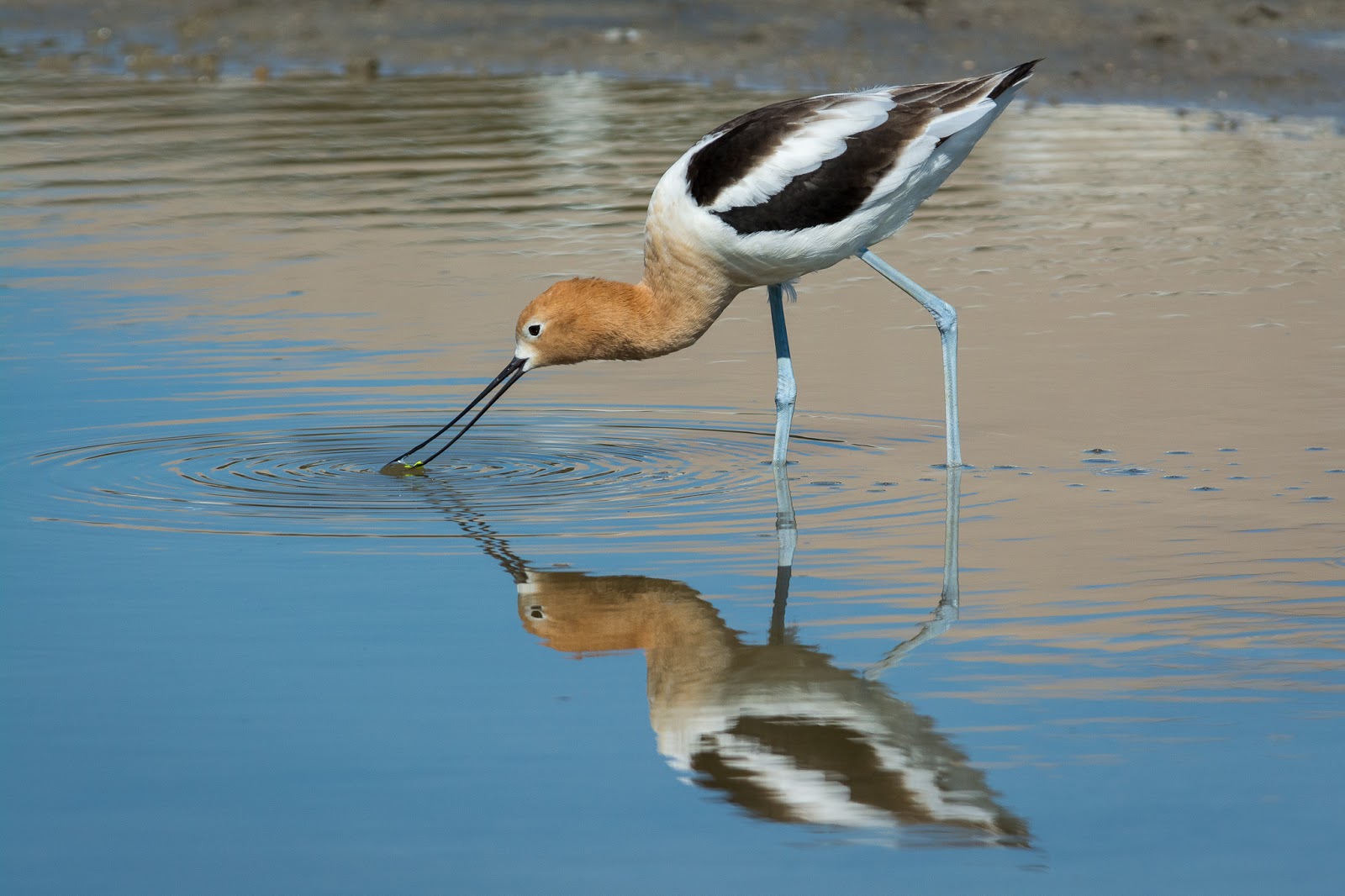
I'm not sure if there was any food in the puddle, but this fellow seemed intent on finding some.

Black Skimmers and American Avocets, Rollover Pass
This behavior was new to me, and I had to do a little research to confirm that it is, in fact, normal.  Black Skimmers apparently do lay flat on the sand like they're dead to rest.  Just nature being unpredictable again!

Related Link: