What's better than one hike in the United States' only tropical rainforest? Two hikes! So after my short trek on the Arboles Grandes Trail, John and I headed to the Mt. Britton Trail.
I actually spotted these striking metallic blue beetles before John did. He wasn't sure what they were, and I haven't been able to find a definitive identity for them online, either. The closest I've seen is the blue milkweed beetle, which is only supposed to be found in western North America.
When you get up over 2,500 feet above sea level, you get into cloud forest. There's less sound than lower down where the birds are more active. And certainly lower visibility. Truly a different world.
And as John warned when we started, in a rainforest you also get rain. I thought I might be able to get an interesting shot looking up at Mt. Britton Tower with raindrops on the lens, but didn't quite get the effect I was hoping for. The most interesting thing about the image to me is the drop that looks like a face in the lower left.
This one from inside the tower was more along the lines of what I was hoping for. The orange on the stones is a type of lichen.
The tower is not especially tall -- just 40 steps. But somehow by the time I got to the top, the sun was out. Rain apparently comes and goes quickly in El Yunque.
I like how the difference in shading on the various ridges in this scene really emphasizes the depth and distance.
John actually knew of a specific plant in a specific spot where we were likely to see a stick insect. And sure enough, we did.
Why do I love getting guides so much when I go places I've never been? So I can see things like Juan Diego Falls. After finishing Mt. Britton Trail we had some time left before I needed to get back to catch my flight home, so John decided we could squeeze this in. The trail to it is short, but not really marked. I would never have gotten to experience this spot on my own.
Given more time I might have tried to find a path to the upper falls. Not that there was anything wrong with the view right where I was.
A final fallen Cecropia leaf capturing a variety of hues on a single palette, and we were done. We crammed in so much in such a short time -- just four hours in the forest -- that it was hard to get my brain around it all. But thankfully I have my photos to help reinforce the amazing memories of it all. :)
Photos from one guy's travels around the world -- from UNESCO World Heritage Sites to national parks to his own backyard in Colorado, and lots of places in between.
Showing posts with label Puerto Rico. Show all posts
Monday, November 4, 2013
El Yunque: Mt. Britton Trail
Topics and References:
Fall,
Hiking,
Insects,
Photos,
Puerto Rico,
Waterfalls
Thursday, October 31, 2013
El Yunque: Arboles Grandes Trail
The big finish to my Puerto Rican visit came Saturday morning with a guided tour of El Yunque National Forest. Danelle found me a terrific guide named John Druitt, a British expatriate who moved to the island 30 years ago. He picked me up at 7:00 and after some discussion of my interests (hiking and photography) decided that the Arboles Grandes Trail would be a worthy endeavor. So that's where we headed.
The environment is so completely different than what I'm used to. Looking up toward the treetops made me feel like I was on the set of Avatar.
I can't even imagine how easy it must be to get lost with the vegetation so dense. Take a few steps off the trail, lose your bearings and I expect you could get yourself in a tough spot.
John had spent time in the Amazon researching medicinal plants, and a couple of years living off the land when he first moved to Puerto Rico. His knowledge of the flora and willingness to share it was a huge treat, such as when he pointed out extensive above-ground root systems like this one.
He explained that the white underside of Cecropia leaves are what gave the forest its name. The native word for white sounded like the Spanish "yunque," which means anvil. But the Spaniards thought they were just mispronouncing their word. So, Anvil Forest. Brilliant.
Not much fauna to speak of, though I really hadn't expected any. This anole posturing on the side of a tree was the highlight as far as that went. At least he was patient enough to wait for me to set up my tripod and get a nice, sharp shot. I probably should have tried to get in a little closer, but I didn't want to scare him off.
La Mina Falls is the highlight of the hike -- 40 beautiful feet of cascading water.
The overcast skies provided the right sort of low contrast light to get some pretty decent shots.
Indulge me in just one more. I don't get to shoot a lot of tropical waterfalls. :)
The trail isn't that long -- about a mile and a half from end to end. Nor is it particularly steep, especially considering what I routinely hike in Colorado. But the humidity was something I really struggled with. As in, I was sweating like whatever pigs tell each other they're sweating like when they want to get the message across that they're really sweating.
The second half of the trail follows the river that feeds the falls. I could have stopped every 50 feet for a new picturesque mix of rocks, water and lush vegetation.
Not much color other than shades of green. So a little pink flower like this really stands out. John told me what it was, but unfortunately I forgot.
This rusted ring of metal was apparently left over from a gold mining operation. People had first tried to convert it into art. Now nature is taking its turn.
The trail was exactly what I was hoping for -- a little bit of a workout packed with a lot of beautiful scenery. :)
Topics and References:
Fall,
Flowers,
Hiking,
Photos,
Puerto Rico,
Reptiles,
Waterfalls
Tuesday, October 29, 2013
Old San Juan
After two hours in El Morro I still had a couple of hours of light left. The question then became how much of the rest of Old San Juan I could see in that time!
I started wandering east figuring I'd make my way to San Cristobal Castle. But I made sure not to focus too much on what was ahead of me and turned back to look at the pathway to El Morro. The silhouettes of people walking toward the citadel, tiny as ants on the broad green expanse, with the sun partially obscured by large, textured clouds struck me as unique and interesting.
Santa María Magdalena de Pazzis Cemetery, the final resting place of many of Puerto Rico's most prominent natives and residents.
Made in England using iron ore, Old San Juan's famous blue cobblestones were brought to the New World as ballast in ships and dumped at the harbor to make room for more valuable cargo. The iron gives the stones their color, which shifts depending on the heat, sun, and humidity.
The Plaza de Armas of San Juan was designed to serve as the original main square for the city. The square's main feature is a round fountain with four statues called "The Four Seasons." I'm guessing this one is winter.
Colon Plaza is at the entrance to Old San Juan and contains this statue of Christopher Columbus at its center.
More garitas! This one is right outside the entrance to San Cristobal Castle, and I was able to get some decent color from the setting sun despite the overcast skies.
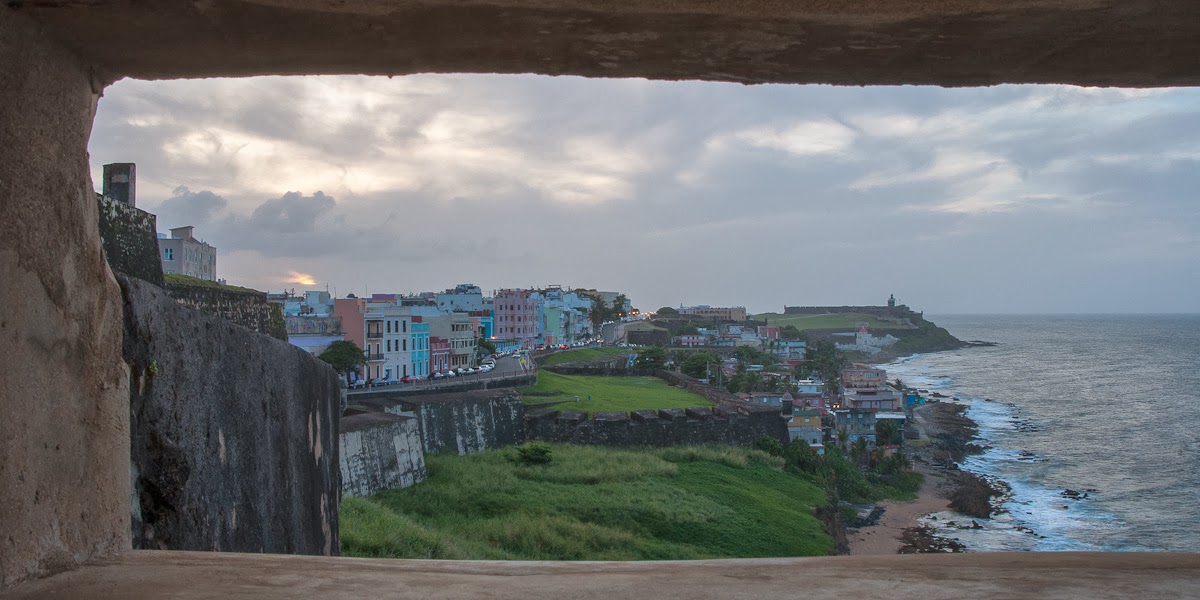
An observation post was built onto the castle in WWII, which seems a bit like overkill to me given all the sentry boxes it already had. Here's the view to the west down Boulevard Del Valle through its narrow slit.
Marbles? Blueberries? Nope -- a stack of cannonballs on the main plaza.
The citadel flies the American flag, the Puerto Rican flag and the Cross of Burgundy flag, the old Spanish military flag.
Colon Plaza after sunset. I was hoping for more people on a Friday night to get a little energy in the shot. But then again, I'm just not that good at shooting people. So maybe an empty plaza was for the best. :)
I'm starting to get better at shooting on a tight schedule. But I think I'd really like to move at a more leisurely pace again sometime soon!
Topics and References:
Fall,
Photos,
Puerto Rico,
San Juan National Historical Site,
UNESCO World Heritage site
Sunday, October 27, 2013
El Morro
I participated in a digital marketing summit this past week organized by Yodle, a prominent local internet marketing company. Not especially worthy of note. But they chose to hold it in San Juan, Puerto Rico. That meant a chance to tack on some time after the sessions were over and get out to shoot some pictures. First stop: the 16th-century Spanish citadel known as Castillo San Felipe del Morro.
I can only assume that the fortress had more formidable guards at its entrance during its heyday. This fellow didn't seem particularly interested in stopping anyone.
The sentry boxes around the walls are the most visually recognizable features of the structure. Known as garitas, they've become a cultural symbol of Puerto Rico itself. I'm usually an adherent to the rule of thirds, but the perspective straight down the path leading to the box called for a centered shot.
I don't know what this fortified post inside the fortress was for. I just found its weathered appearance and tiny battlements interesting.
El Morro protected San Juan Bay and by extension Spain's interests in the New World for nearly 400 years.
Really, it was difficult to take a shot that didn't have a sentry box in it.
The nautilus-like underside of a spiral staircase placed to give soldiers quick access between levels of the fortress.
I don't mind how blown out the doorway to the outside ended up in this shot from the inside of the second level tower. It lends an almost supernatural mystery to what awaits at the bottom of the stairs.
In a fairly short time, I got to see garitas from just about every imaginable angle.
And another centered shot from a guy who almost never tries this sort of perspective. I like the light and shade of these archways.
I'm no military expert. But I'm pretty sure that metal grill would not help the effectiveness of that cannon one bit. Then again, not much would probably help that cannon any more.
Spent a wonderful couple of hours wandering around this impressive fortress, and gained a firsthand appreciation of Spain's military prowess during the colonization of the New World.
Topics and References:
El Morro NM,
Fall,
Photos,
Puerto Rico,
San Juan National Historical Site,
UNESCO World Heritage site
Subscribe to:
Posts (Atom)