Showing posts with label Galápagos Islands National Park. Show all posts

Sunday, December 29, 2019

El Chato Ranch

Our trip to the Galápagos Islands was a completely magical experience, even before we made our final stop.  That final stop might as well have been Jurassic Park given the amazing prehistoric creatures we got to see at El Chato Ranch.

El Chato Reserve, Santa Cruz Island
The ranch was once part of a larger farm dedicated to livestock farming.  The Arias family who owns the property have spent 20 years converting it into habitat for giant tortoises.

Small Ground Finch, El Chato Reserve, Santa Cruz Island
Of course, giant tortoises aren't the only ones who appreciate the family's efforts.  Small ground finches like this one were also prevalent.

Santa Cruz Island Giant Tortoise, El Chato Reserve
But not even the finches were as plentiful as the wildlife the ranch was designed for.  Santa Cruz Giant Tortoises were practically everywhere you looked.

Monarch Butterfly, El Chato Reserve, Santa Cruz Island
Did I mention that the tortoises weren't the only striking wildlife?  Being in the highlands meant a much wetter environment than we'd previously seen, which was appealing to butterflies like this Monarch.

Santa Cruz Island Giant Tortoise, El Chato Reserve
The tortoises lived up to their reputation for being slightly less than speedy.  At times, it was hard to tell if we were amidst actual living creatures or simply statues.

Small Ground Finch, El Chato Reserve, Santa Cruz Island
This finch looked like he had just heard something he couldn't quite believe.  There may be a meme in here somewhere.

Santa Cruz Island Giant Tortoise, El Chato Reserve
Fun fact about giant tortoises: They are messy eaters.

Santa Cruz Island Giant Tortoise, El Chato Reserve
Really messy eaters.

Santa Cruz Island Giant Tortoise, El Chato Reserve
Really, incredibly gross eaters.  But, I guess that kind of comes along with having neither teeth nor hands.

Santa Cruz Island Giant Tortoises, El Chato Reserve
The highest concentration of tortoises were found at the watering hole.  If I weighed 500 pounds, I'd probably like the help of a little water to haul some of that bulk around, too.

Smooth-billed Ani, El Chato Reserve, Santa Cruz Island
This Smooth-billed Ani was a bird I'd never even heard of before, let alone photographed.

Smooth-billed Ani, El Chato Reserve, Santa Cruz Island
These large birds are part of the cuckoo family, and can actually also be found in southern Florida.  Learning things!

Santa Cruz Island Giant Tortoise, El Chato Reserve

As much as I'd like to think a sign like this shouldn't be necessary, I also realize we live in a world where people eat Tide Pods.  So ¯\_(ツ)_/¯.

Santa Cruz Island Giant Tortoise, El Chato Reserve
Closing out our trip in the company of these gentle giants was the perfect end to this unforgettable expedition.  I know exactly how blessed I am to have had this opportunity, and I'm incredibly grateful for it!

Click here for more blog posts from my amazing visit to the Galápagos Islands!

Saturday, December 28, 2019

Santa Cruz Island

We had come nearly full circle on our expeditionary cruise around the Galápagos, returning to Santa Cruz Island. Our final afternoon saw us in the island's northwestern corner for a hike to the top of Dragon Hill, so named for being one of the only places on the island where land iguanas could be found.

Santa Cruz Island
The sun was quite literally smiling on us, with stunning skies that mirrored the beautiful blue waters. 

Santa Cruz Island
I'm not sure who made these tracks on the beach.  Sea lion, I guess?  Whoever it was, I picture a galumphing gait and a bit of a hurry.

Santa Cruz Island
Shout out to the Sally Lightfoot Crab who provided a nice splash of color on the beach.

Ecuadorian Hermit Crab, Santa Cruz Island
Speaking of crabs, I enjoyed spotting this Ecuadorian Hermit Crab making its way across the sand.

Marine Iguanas, Santa Cruz Island
A small group of marine iguanas had headed slightly inland to bask on the edge of a brackish lagoon.

Black-necked Stilt, Santa Cruz Island
A familiar bird from past visits to the Galveston area -- a Black-necked Stilt -- was also enjoying the lagoon.

White-cheeked Pintail, Santa Cruz Island
We had a second encounter of the day with White-cheeked Pintails, but this time much closer and in much better light.  The end result: a much better picture!

White-cheeked Pintail, Santa Cruz Island
If you were unsure how dabbling ducks got their name, here's a pretty good illustration.  Our friend here was looking for plants and seeds in the soft mud.

Santa Cruz Island
The lagoon was apparently bigger during wetter parts of the year.

Dragon Hill, Santa Cruz Island
Dragon Hill was aptly named.  Not so much for its "dragons," but for its prominence relative to the surrounding landscape.

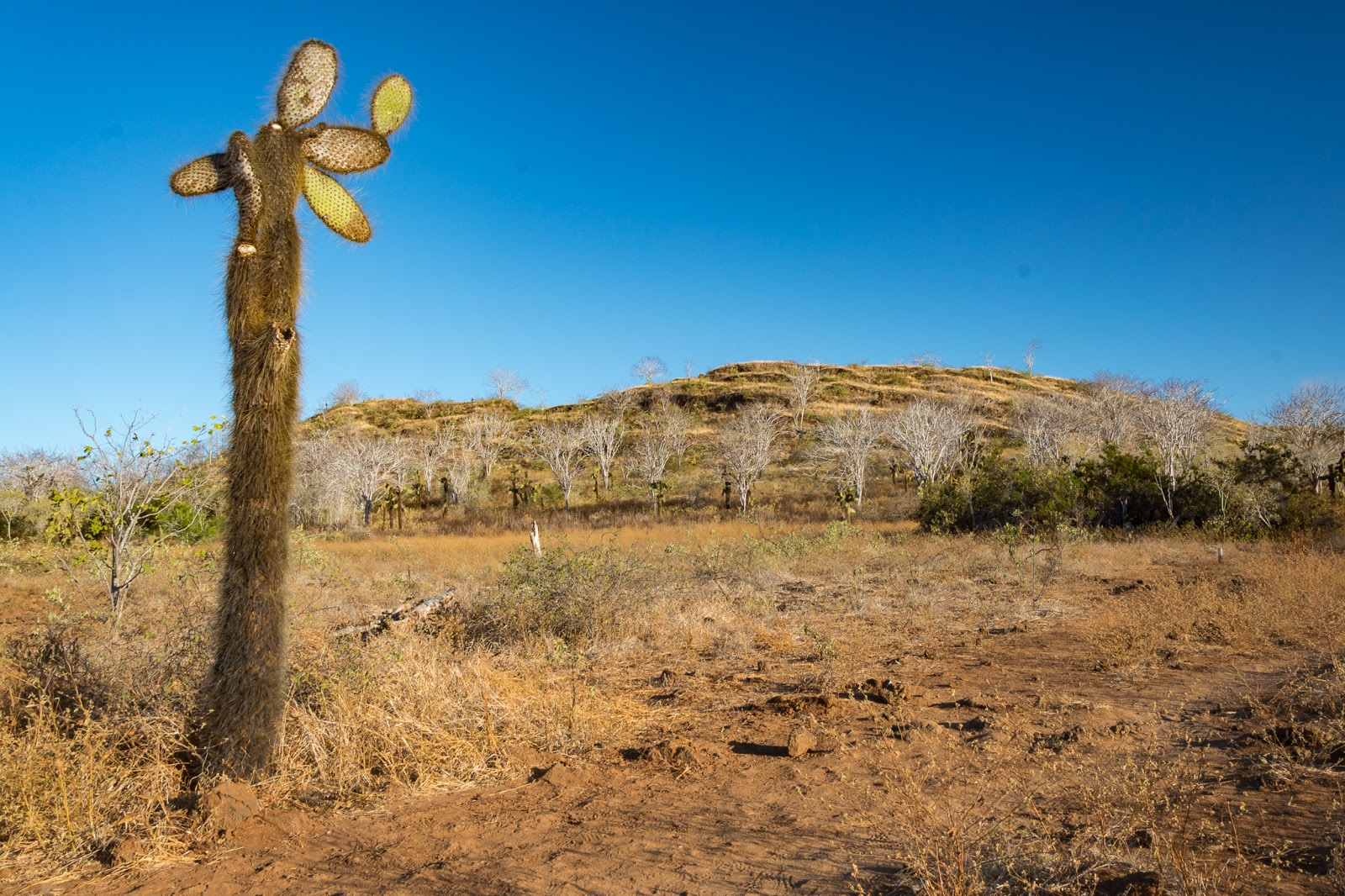
Backlit Opuntia Cacti, Santa Cruz Island
The late afternoon sun provided some nice backlight to the plentiful cacti.

Backlit Opuntia Cactus, Santa Cruz Island
The glow of the spines was nicely magnified when, well, magnified.

Santa Cruz Island
The hike was relatively short, and provided a nice view back to the ocean.

Our visit was rapidly winding down.  The next day would see us board a plane back to the mainland.  But we still had one more highly anticipated stop to make!

Click here for more blog posts from my amazing visit to the Galápagos Islands!

Tuesday, December 24, 2019

Rabida Island, Part 2

The sun had burned off most of the clouds at the end of our hike on Rabida Island. That gave me more light to shoot the sights on the red sand beach.

Galápagos Sea Lion, Rabida Island
Those sights consisted primarily of sea lions.  And they weren't sleeping!

Galápagos Sea Lions, Rabida Island
It was great to get the chance to observe some interactions between these animals.  Some seemingly tender ...

Galápagos Sea Lions, Rabida Island
... some less so ...

Galápagos Sea Lions, Rabida Island
... then back to tender again.  Sea lion love!

Galápagos Sea Lions, Rabida Island

I suppose it was inevitable that sleep would eventually come.

Galápagos Sea Lion, Rabida Island
This poor creature had gotten itself entangled in some monofilament fishing line.

Galápagos Sea Lion, Rabida Island
Our naturalist took a closer look and confirmed that the fishing line was gone, but the damage had already been done.  And I was getting some pretty strong "no more pictures" signals.

Galápagos Sea Lion, Rabida Island
Well, maybe just one more.

Galápagos Sea Lions, Rabida Island
Water, beach, hill, and sky all converge at roughly the same point in the distance.

Marine Iguana, Rabida Island
Not sure what this marine iguana was up to.  Eating, maybe?

Galápagos Sea Lions, Rabida Island
As the day grew warmer, the sea lions sought out some shady shelter.  Say that five times fast.

Rabida Island
I honestly thought this scene of white trees on a red cliff against a blue sky would turn out more striking than it did.  Still appealing, though.

Click here for more blog posts from my amazing visit to the Galápagos Islands!

Saturday, December 21, 2019

Rabida Island, Part I

Sunday morning of our Galápagos visit saw us at Rabida Island for an early hike.  High levels of iron give the island its distinctive red color.

Galápagos Sea Lion, Rabida Island
On landing we were graced with a male sea lion announcing that he, too, had arrived.

Galápagos Sea Lions, Rabida Island
But his proclamation didn't dissuade the other sea lions on the beach from their favorite pursuit.

Rabida Island
Cloudy skies and light rain joined us at the start of our hike.

Water Morning Glory, Rabida Island
Another of the rare flowers from our visit -- a Water Morning Glory.

Galápagos Mockingbird, Rabida Island
Could this mockingbird look any angrier?

Rabida Island
Even with the overcast skies, the water in this cove is a breathtaking blue.

Small Ground Finches, Rabida Island
I enjoyed seeing several small ground finches all preening in the same tree.

Rabida Island
Our hike peaked on a cliff that overlooked our cruise ship and the beach where we had landed.

Opuntia insularis, Rabida Island
Not surprising to find cacti in the dry climate.

White-cheeked Pintail, Rabida Island
I didn't expect to see ducks, but these White-cheeked Pintails are apparently fairly common.  And also their own unique subspecies.

Western Spotted Orbweaver, Rabida Island
A Western Spotted Orbweaver showed off its striking pattern.

Rabida Island
As we returned to where our hike began, the morning clouds had burned off and the sun was beaming down.  Even bright blue skies couldn't make the small pond of brackish water look appealing, though.

Click here for more blog posts from my amazing visit to the Galápagos Islands!