The final day of our Rhine cruise saw us spend most of of our time in an area known as the "Colmar pocket" in central Alsace, France. The region was held by the German Nineteenth Army late in World War II.
We docked in Breisach overnight, and for some reason I was awake and up early. When I saw the misty conditions, I immediately grabbed my camera and set up on the gangplank for this shot.
We spent our morning in the Black Forest, then returned to the boat for lunch. The mist remained and a bevy of swans were swimming on the river.
Taryn surprised us by asking if we could go on a World War II history tour in the afternoon. When one of your kids asks to do something educational, you agree! So I went with her as we drove around to various points of military significance. I found the most interesting visuals at a comfort stop where a pair of sweet gum trees were still decked in their fall finery, one red ...
... and one gold.
Just as striking as the leaves were the fruit. I especially liked how this one has somehow managed to loop up and over the twig from which it hung.
The mist was back at the top of Mont de Sigolsheim, site of a fierce battle between German and American forces.
For a vacation where taking photos took a back seat to spending time with my family, I'm not unhappy with the shots I got. And this last day provided opportunities that fell right in my wheelhouse, with a clear focus on the region's natural beauty. I hope to come back some time at another time of year for a different perspective on this gorgeous area!
Photos from one guy's travels around the world -- from UNESCO World Heritage Sites to national parks to his own backyard in Colorado, and lots of places in between.
Showing posts with label Germany. Show all posts
Sunday, December 27, 2015
Thursday, December 24, 2015
Black Forest
On Friday of our Rhine cruise, we got away from the river via motor coach to spend some time in Germany's legendary Black Forest. Our destination: the tiny resort of Hofgut Sternen.
Driving from the valley we quickly rose above the clouds into bright blue skies and fresh snow on the ground. The vistas were gorgeous, but I couldn't shoot any of them because there was nowhere on the narrow, winding road to safely stop the bus!
Fortunately, things were still beautiful after we'd descended into the Ravenna gorge. Zak and I ditched our fellow cruise passengers to walk a short ways to see St. Oswald's Chapel, which was dedicated in 1148 as the first local parish church by the Bishop of Constance.
Fresh snow on tree branches always makes for a pretty picture.
The chapel was heavily damaged by aerial bombing toward the end of World War II. A complete restoration was done in 1950.
The Ravennaschlucht Viadukt is an impressive structure. According to Wikipedia, "the bridge was exploded by German forces near the end of World War II and then re-built under the direction of French occupying forces and with the use of German prisoners of war."
A creek ran through the property, cutting a dark path through the white terrain.
A small pond provided a picturesque reflective foreground.
Last shot before hopping back on the bus -- a snow-covered fence that seems to serve as the gateway to an enchanted forest. Like if you hopped over it and started walking, you'd find yourself running into Hansel & Gretel, Little Red Riding Hood, or Elsa & Anna.
Yet another place on our trip that I'd love to have spent more time in. But still delighted to have experienced it at least briefly!
Driving from the valley we quickly rose above the clouds into bright blue skies and fresh snow on the ground. The vistas were gorgeous, but I couldn't shoot any of them because there was nowhere on the narrow, winding road to safely stop the bus!
Fortunately, things were still beautiful after we'd descended into the Ravenna gorge. Zak and I ditched our fellow cruise passengers to walk a short ways to see St. Oswald's Chapel, which was dedicated in 1148 as the first local parish church by the Bishop of Constance.
Fresh snow on tree branches always makes for a pretty picture.
The chapel was heavily damaged by aerial bombing toward the end of World War II. A complete restoration was done in 1950.
The Ravennaschlucht Viadukt is an impressive structure. According to Wikipedia, "the bridge was exploded by German forces near the end of World War II and then re-built under the direction of French occupying forces and with the use of German prisoners of war."
A creek ran through the property, cutting a dark path through the white terrain.
A small pond provided a picturesque reflective foreground.
Last shot before hopping back on the bus -- a snow-covered fence that seems to serve as the gateway to an enchanted forest. Like if you hopped over it and started walking, you'd find yourself running into Hansel & Gretel, Little Red Riding Hood, or Elsa & Anna.
Yet another place on our trip that I'd love to have spent more time in. But still delighted to have experienced it at least briefly!
Topics and References:
Fall,
Germany,
Photos,
Reflections
Location:
Oberhöllsteig, Breitnau, Germany
Sunday, December 13, 2015
Heidelberg
Wednesday on our Rhine River cruise was spent in and around the city of Heidelberg. American author Mark Twain was a huge fan, spending three months there in the late 1800s and writing lovingly about the city in his book, A Tramp Abroad.
We made our way first to Heidelberg Castle, whose earliest structure was built before 1214. Over the years, repeated damage from lightning and wars has left much of the structure in ruins. Dicker Turm tower was destroyed in 1689, and bears a plaque flanked by statues of the Elector Louis V (left) and Frederick V (right).
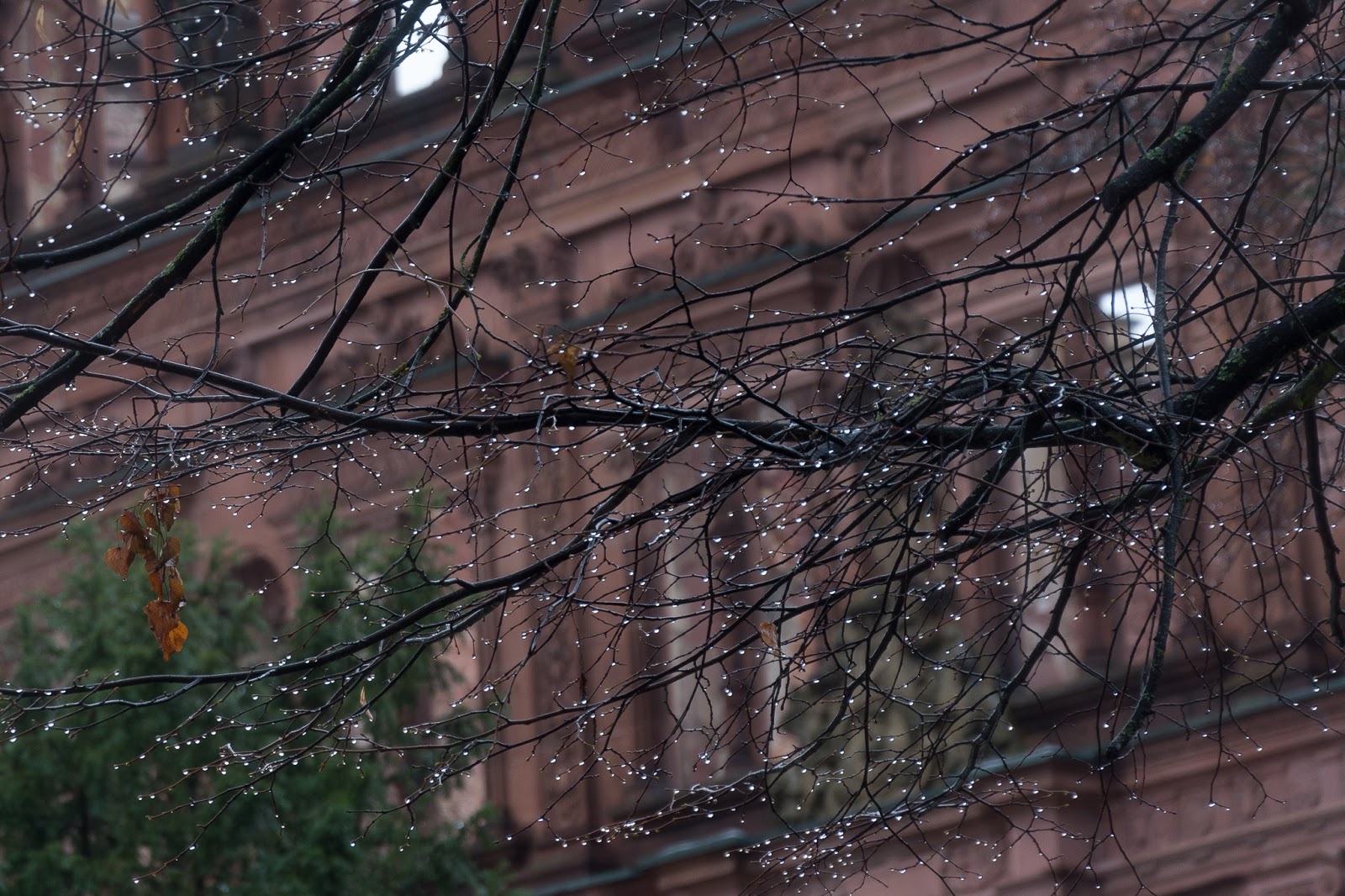
I always appreciate the look of dead foliage, especially seed pods. I love how stark things look here with the bare branches, water droplets, and stone background.
Being situated about 260 feet uphill from the river, the rain falling down in the city was snow up at the castle. The castle entrance is through this tower, across a bridge that spans the former moat.
The palace was built and extended over three centuries in different styles, including Gothic and Renaissance.
Looking back at my pictures, I'm surprised how often my eye shifted from the actual architecture to elements like these bare branches covered in water droplets. I guess that's just the nature photographer in me.
Our cruise director gave me a tip to head out to a terrace for a great view of the Neckar Valley across Heidelberg's Old Town. The thick clouds on the opposite hills and dusting of snow added some nice elements to the view.
As we left the castle I was able to stop and turn back for a shot of the medieval guards that look over the entrance gate.
We returned to the city for lunch and some more Christmas markets, including one in the town's Marktplatz that features the "Heidelberg Christmas Pyramid," a larger-than-life version of the candle-bearing table ornaments that are popular in Germany and Central Europe during Advent.
One last shot across the Neckar before we boarded our buses to return to the Viking Idi.
I enjoyed Heidelberg, even feeling that between the weather and being part of a tour group I barely got to experience the city at all. Hopefully I'll get the opportunity to return for a longer visit at a different time of year!
We made our way first to Heidelberg Castle, whose earliest structure was built before 1214. Over the years, repeated damage from lightning and wars has left much of the structure in ruins. Dicker Turm tower was destroyed in 1689, and bears a plaque flanked by statues of the Elector Louis V (left) and Frederick V (right).
I always appreciate the look of dead foliage, especially seed pods. I love how stark things look here with the bare branches, water droplets, and stone background.
Being situated about 260 feet uphill from the river, the rain falling down in the city was snow up at the castle. The castle entrance is through this tower, across a bridge that spans the former moat.
The palace was built and extended over three centuries in different styles, including Gothic and Renaissance.
Looking back at my pictures, I'm surprised how often my eye shifted from the actual architecture to elements like these bare branches covered in water droplets. I guess that's just the nature photographer in me.
Our cruise director gave me a tip to head out to a terrace for a great view of the Neckar Valley across Heidelberg's Old Town. The thick clouds on the opposite hills and dusting of snow added some nice elements to the view.
As we left the castle I was able to stop and turn back for a shot of the medieval guards that look over the entrance gate.
We returned to the city for lunch and some more Christmas markets, including one in the town's Marktplatz that features the "Heidelberg Christmas Pyramid," a larger-than-life version of the candle-bearing table ornaments that are popular in Germany and Central Europe during Advent.
One last shot across the Neckar before we boarded our buses to return to the Viking Idi.
I enjoyed Heidelberg, even feeling that between the weather and being part of a tour group I barely got to experience the city at all. Hopefully I'll get the opportunity to return for a longer visit at a different time of year!
Location:
Heidelberg, Germany
Thursday, December 10, 2015
Upper Middle Rhine Valley
Tuesday of our Thanksgiving week vacation saw us spending the day sailing through the historic Upper Middle Rhine Valley, home to castles, historic towns, and vineyards.
Our ship docked in Koblenz at the Deutsches Eck, a headland where the Moselle and Rhine Rivers meet. The area features a monument to German emperor William I and three parts of the Berlin Wall. My eye was most drawn to an extremely solid-looking mooring ring with its green patina.
From Koblenz we took a motorcoach to Marksburg Castle, which has the distinction of being the only hill castle on the Rhine that has never been destroyed. The view up the river from the castle walls was impressive.
This image is actually a merge of two shots to get good exposure on both the close stonework and distant river.
Many areas of the castle were outfitted with period furnishings and paraphernalia, including the blacksmith shop.
Though the trees were bare of leaves, they still had plenty of greenery courtesy of moss which seems to thrive in the humid air.
Some vines were still quite vibrant in the late November cold.
The lighting conditions were not ideal for shooting castle portraits, with the skies being about as uniformly gray as possible. Still, I felt the need to at last shoot some for documentation. So here's the view we had of Marksburg as we got back onto our ship in Braubach.
The afternoon was spent sailing down the river past a number of other castles, including a pair in close proximity with an odd naming coincidence. I give you Maus Castle ...
... and Katz Castle!
Living like we do in a town that was just incorporated in 1961, seeing and visiting places whose recorded history goes back more than a thousand years is a treat in any weather!
Our ship docked in Koblenz at the Deutsches Eck, a headland where the Moselle and Rhine Rivers meet. The area features a monument to German emperor William I and three parts of the Berlin Wall. My eye was most drawn to an extremely solid-looking mooring ring with its green patina.
From Koblenz we took a motorcoach to Marksburg Castle, which has the distinction of being the only hill castle on the Rhine that has never been destroyed. The view up the river from the castle walls was impressive.
This image is actually a merge of two shots to get good exposure on both the close stonework and distant river.
Many areas of the castle were outfitted with period furnishings and paraphernalia, including the blacksmith shop.
Though the trees were bare of leaves, they still had plenty of greenery courtesy of moss which seems to thrive in the humid air.
Some vines were still quite vibrant in the late November cold.
The lighting conditions were not ideal for shooting castle portraits, with the skies being about as uniformly gray as possible. Still, I felt the need to at last shoot some for documentation. So here's the view we had of Marksburg as we got back onto our ship in Braubach.
The afternoon was spent sailing down the river past a number of other castles, including a pair in close proximity with an odd naming coincidence. I give you Maus Castle ...
... and Katz Castle!
Living like we do in a town that was just incorporated in 1961, seeing and visiting places whose recorded history goes back more than a thousand years is a treat in any weather!
Topics and References:
Castle,
Fall,
Germany,
Photos,
UNESCO World Heritage site,
Upper Middle Rhine Valley
Location:
Braubach, Germany
Tuesday, December 8, 2015
Cologne by Night
After a great day in Cologne and a delicious dinner on board the Viking Idi, we ventured back into town after dark.
Our main purpose was to check out the lights of the Christmas Market. Paper lanterns and purple spotlights in the trees were a bit unexpected, but still striking.
The wooden shops and cobblestone streets had an undeniable charm, especially when watched over by an apparent tree spirit of some sort.
The main market came complete with a small Ferris Wheel, which wasn't actually spinning as fast as this long exposure seems to imply.
Where there's a Ferris Wheel, a carousel can't be far off. This mount seemed to be eagerly awaiting a young rider.
The area around the statue of Friedrich Wilhelm III had been turned into an ice skating rink, with a solid crowd of skaters late on a weeknight.
We enjoyed about an hour of meandering and browsing before returning to our ship, ready for a good night's sleep and a new adventure the next day!
Our main purpose was to check out the lights of the Christmas Market. Paper lanterns and purple spotlights in the trees were a bit unexpected, but still striking.
The wooden shops and cobblestone streets had an undeniable charm, especially when watched over by an apparent tree spirit of some sort.
The main market came complete with a small Ferris Wheel, which wasn't actually spinning as fast as this long exposure seems to imply.
Where there's a Ferris Wheel, a carousel can't be far off. This mount seemed to be eagerly awaiting a young rider.
The area around the statue of Friedrich Wilhelm III had been turned into an ice skating rink, with a solid crowd of skaters late on a weeknight.
We enjoyed about an hour of meandering and browsing before returning to our ship, ready for a good night's sleep and a new adventure the next day!
Location:
Cologne, Germany
Friday, December 4, 2015
Cologne by Day
Cologne is far more than just its famous cathedral. Our entire day there was filled with beautiful scenes and visuals.
In fact, the beautiful visuals began before we even made it to Cologne. Our ship docked in Zons, and right outside our cabin window was a dormant tree gorgeously lit by the morning sun. One thing I've been told repeatedly about photography is that an ordinary scene in special light is better than a special scene in ordinary light. Images like this really help drive that point home.
The late Gothic style tower of the Cologne City Hall boasts an impressive 130 stone statues and the famous "Platzjabbeck," a wooden face sculpture which opens its mouth and sticks out its tongue when the tower clock strikes the hour.
The Great Saint Martin Church rests on remnants of a Roman chapel, built on what was then an island in the Rhine, and is a landmark of Cologne's Old Town.
The equestrian statue in Cologne’s Heumarkt Square of Friedrich Wilhelm III, King of Prussia from 1770 to 1840, was dedicated in 1878.
Lights hung festively in trees over one of the city's seven Christmas Markets. We were fortunate that the markets opened the day we arrived in town.
I don't love the light on the front of the City Hall in this shot. Frankly, the tower was probably in better light from just about any other angle. But the clouds behind the tower were striking enough that I felt I had to capture them.
The city was definitely beautiful by day. In my next post, I'll share some of what we saw when we came back that night!
In fact, the beautiful visuals began before we even made it to Cologne. Our ship docked in Zons, and right outside our cabin window was a dormant tree gorgeously lit by the morning sun. One thing I've been told repeatedly about photography is that an ordinary scene in special light is better than a special scene in ordinary light. Images like this really help drive that point home.
The late Gothic style tower of the Cologne City Hall boasts an impressive 130 stone statues and the famous "Platzjabbeck," a wooden face sculpture which opens its mouth and sticks out its tongue when the tower clock strikes the hour.
The Great Saint Martin Church rests on remnants of a Roman chapel, built on what was then an island in the Rhine, and is a landmark of Cologne's Old Town.
The equestrian statue in Cologne’s Heumarkt Square of Friedrich Wilhelm III, King of Prussia from 1770 to 1840, was dedicated in 1878.
Lights hung festively in trees over one of the city's seven Christmas Markets. We were fortunate that the markets opened the day we arrived in town.
I don't love the light on the front of the City Hall in this shot. Frankly, the tower was probably in better light from just about any other angle. But the clouds behind the tower were striking enough that I felt I had to capture them.
The city was definitely beautiful by day. In my next post, I'll share some of what we saw when we came back that night!
Topics and References:
Fall,
Germany,
Photos,
Silhouette
Location:
Cologne, Germany
Wednesday, December 2, 2015
Cologne Cathedral
The best weather of our entire trip came on our day in Cologne. Mostly sunny morning skies provided beautiful light in which to visit and shoot the Cologne Cathedral, another UNESCO World Heritage site that dates back to 1248 and is the country's most visited landmark.
It's hard to get my brain around something that is nearly a thousand years old and still in active use. That sense of history was a recurring theme throughout our trip.
Construction of this Gothic masterpiece took place in several stages over seven centuries and wasn't completed until 1880.
I was fortunate to get an unobstructed shot of the ornate western door.
Our guide pointed out the crest of Cologne on one of the stained glass windows.
An abstract pattern of 11,500 squares of glass in 72 colors fill a 20-meter-high window designed by Gerhard Richter. The "pixelated" window, as my kids called it, was installed in 2007 to replace a plain glass window that had itself replaced the original window that had been destroyed in World War II.
The light shining through the new window creates interesting patterns on some of the interior statuary.
The most celebrated work of art in the cathedral is the Shrine of the Three Kings, created in 1190 and traditionally believed to hold the remains of the Three Wise Men, whose relics were acquired by Frederick Barbarossa at the conquest of Milan in 1164.
Visitors get the opportunity to climb the 533 steps to the top of the cathedral's south tower, where a look up reveals some of the incredible attention to detail that was paid even to places that the craftspeople had to believe nobody would ever see up close.
The exterior platform is enclosed in wire mesh for safety. I had to stick my camera lens right up to the fencing to get a shot without any of the actual wire in it. Still not a bad effort; it's amazing how a gorgeous view and fantastic light can do that. :)
Cologne was probably my favorite stop of our trip, and our time at the cathedral was a big reason why.
It's hard to get my brain around something that is nearly a thousand years old and still in active use. That sense of history was a recurring theme throughout our trip.
Construction of this Gothic masterpiece took place in several stages over seven centuries and wasn't completed until 1880.
I was fortunate to get an unobstructed shot of the ornate western door.
Our guide pointed out the crest of Cologne on one of the stained glass windows.
An abstract pattern of 11,500 squares of glass in 72 colors fill a 20-meter-high window designed by Gerhard Richter. The "pixelated" window, as my kids called it, was installed in 2007 to replace a plain glass window that had itself replaced the original window that had been destroyed in World War II.
The light shining through the new window creates interesting patterns on some of the interior statuary.
The most celebrated work of art in the cathedral is the Shrine of the Three Kings, created in 1190 and traditionally believed to hold the remains of the Three Wise Men, whose relics were acquired by Frederick Barbarossa at the conquest of Milan in 1164.
Visitors get the opportunity to climb the 533 steps to the top of the cathedral's south tower, where a look up reveals some of the incredible attention to detail that was paid even to places that the craftspeople had to believe nobody would ever see up close.
The exterior platform is enclosed in wire mesh for safety. I had to stick my camera lens right up to the fencing to get a shot without any of the actual wire in it. Still not a bad effort; it's amazing how a gorgeous view and fantastic light can do that. :)
Cologne was probably my favorite stop of our trip, and our time at the cathedral was a big reason why.
Topics and References:
Cologne Cathedral,
Fall,
Germany,
Photos,
UNESCO World Heritage site
Subscribe to:
Posts (Atom)